The Rainbow Diet Pills There and Back Again
The rainbow diet pills: at that place and back again

* This post contains spoilers for Requiem for a Dream.
Last night I re-watched Requiem for a Dream, a Darren Aronofsky masterpiece that is possibly the virtually gut-wrenching, emotional rollercoaster of a movie always made in cinematic history.Requiem tells the story of iv people descending into habit, eventually sacrificing their bodies, minds and dignity for their drug-of-choice.
A particularly harrowing narrative is that of Sarah Goldfarb, an elderly woman who begins taking colourful diet pills throughout the mean solar day to slim downward for a potential advent on TV and "be somebody". Her wishes were never fulfilled – instead she is consumed by hallucinations and delusions. Her story ends with a torturous scene in which she is subjected – without anesthesia – to ECT (electroconvulsive therapy).
A lot can be said about the movie. Simply this time effectually, ane question peeked my interest: is Sarah'south addiction story based on historical facts? What were diet pills like back in the 1970s? Although the film never discloses what the pills contain, nosotros can make a few rational assumptions based on their effects: they send Sarah into a frenzy of activity, increases her trunk temperature, triggers jaw-clenching and kills her ambition. Amphetamines certainly fit the nib, simply they are far, far from the whole story.

Sarah getting hooked on diet pills. Source: celebratingcinema.blogspot.com
Dangerous colours
First introduced in the 1950s, amphetamines quickly gained popularity for their potent ambition suppression effects. Phentermine, an amphetamine derivative still on the market today, was approved by the FDA in 1959 and hailed every bit "mother'south picayune helper" for their free energy-boosting effects. Obetrol, a pill popular in the 1960s and later reformulated as Adderall, contained a toxic mix of amphetamine (speed), methamphetamine (meth) and dextroamphetamine(dex) salts jump to get y'all college than the heaven. Amphetamines generated considerable interest among physicians eager to capitalize on their actions. There was only ane problem: people didn't like being "tweaked out" at the end of the mean solar day.
The solution was simple and terrifying. Drug companies began formulating combination diet pills, which included amphetamines, diuretics, laxatives and thyroid hormones to send the torso into weight-loss overdrive, as well as benzodiazepines, barbiturates, corticosteroids and antidepressants to deal with nuances like insomnia and anxiety (meet Tabular array below). These uppers and downers came in brightly colored capsules and tablets, and the government was given the innocuous, hopeful-sounding name the "rainbow diet pills".
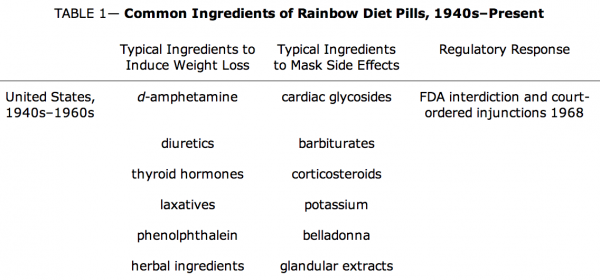
Betwixt the 1950s and 70s, a slew of small firms sprung up to direct marketplace rainbow pills to physicians – particularly to those unbound by ethics and eager for some extra dough. The businesses built upwardly a façade of personalized medicine, purposefully manufactured pills with dozens of colours to ensure that each patient would receive his or her own combination of coloured pills. Their marketing tactics worked. By 1967, weight loss clinics were pulling in $250 million each yr in patient fees, with an additional $120 million on rainbow pills alone. As any commencement year pharmacist (or seasoned drug user) tin tell you: mixing uppers with downers is a very, very bad idea. (Think pharmaceutical grade speedball.) Before the turn of the decade, over 60 deaths and astringent adverse furnishings prompted the FDA to mass seize the pills from the manufacturers and tighten regulatory command of amphetamine-based medications. The manufacture withdrew into the shadows, simply the damage was done.
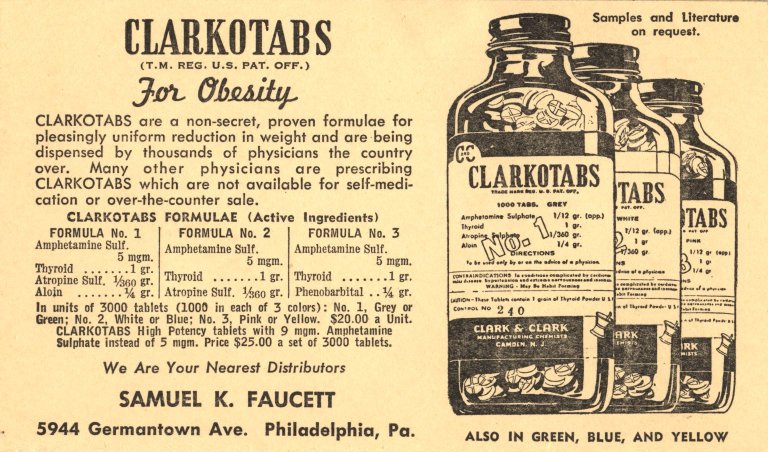
Clarkotabs: i of the starting time combination diet pill formulations. Source: http://ihm2.nlm.nih.gov/
Tolerance to amphetamines builds up fast. Chronic apply lowers the drugs' efficacy, and an uneducated patient may believe that they had stopped working birthday. And herein lies the danger. Although each pill generally independent a relatively safe dose of a particular drug, some patients resorted to stacking pills to speed upwardly or restart weight loss – sometimes taking upward to 4 times the suggested amount. Worse nonetheless is the combination. Thyroid hormones lone can trigger heart palpitations. Diuretics and laxatives deplete the body of potassium, an electrolyte that's crucial for keeping the center beating at a normal rhythm. Add in a hefty dose of digitalis or ephedrine – both herbal compounds that promote weight loss – and normal heartbeats are reduced to useless quivers. A 1967 article in Times magazine reported the deaths of at least 6 Oregon women who overdosed on rainbow pills. The toxic combination had stopped their hearts, and they died solitary.
Speedy psychosis
In Requiem, Sarah descended into madness later on repeatedly stacking her upper pills. In one jarring scene, she watched in horror as her younger self apparated out of her Goggle box set and into the living room, whereby immature Sarah cruelly laughed at the antiquated fixtures and mocked her living weather.
Chronic, high-dose consumption of amphetamine derivatives are known to trigger psychosis like to that in schizophrenia: paranoia, delusions, also every bit auditory and visual hallucinations. Historically these side effects were thought to exist associated with methamphetamine abuse, not prescription rainbow pills. The earliest sign of trouble came from a 1964 instance report, which documented the mental breakdown of a 26-year old woman subsequently consuming phentermine – the most popular amphetamine used for diet command and weight loss. Similar stories are littered beyond the medical literature spanning decades. In 1977, after one calendar month of taking phentermine, a 20-year old woman became distraught, stating intense feelings of déjà vu and was convinced that her mother and college classmates were out to get her. In another example reported in 2005, a 30-year-erstwhile woman took Xenadrine (an OTC weight-loss supplement) and phentermine purchased over the internet, and within 3 weeks developed delusions of men stalking her. The woman's symptoms improved after replacing diet pills with anti-psychotics, simply came back with a vengeance in one case she restarted her Xenadrine/phentermine philharmonic. Neither woman had any family history of psychiatric disorders, nor had they previously experienced any psychotic episodes prior the use of diet pills.
Despite numerous reports, no i has pooled existing information into a meta-analysis to try to pinpoint phentermine (or any other upper component of rainbow pills) as the psychosis-triggering amanuensis. Even today physicians are withal divided in the exact role of amphetamines in acute psychosis. Are the drugs precipitating psychotic episodes in those at risk for schizophrenia? Or can they cause psychosis in otherwise healthy individuals?

Care to guess what the bottles contain?
The rainbow pills return
After lurking in the shadows for over two decades, rainbows pills accept reappeared on the market under the guise of herbal weight loss supplements. In 2005, the FDA confiscated thousands of bottles of imported herbal "fatty burning" supplements adulterated with benzos, fenproperex (an amphetamine derivative) and the anti-depressant fluoxetine. 1 survey of rainbow pill takers in Massachusetts revealed at over two thirds experienced insomnia, feet or other adverse effects; another written report from the Texas Poison Centre Network institute imported rainbow pills every bit the culprit for high claret pressure, vomiting and unnaturally rapid middle trounce. Marketed with trendy labels similar "all natural", "herbal extract" and "organic", these new generation combo nutrition pills are just as dangerous as their 1970s predecessors. Due to the 1994 Dietary Supplement Act, which states that dietary supplements exercise not require premarket review, the FDA is powerless to stop the pills from striking store shelves in the first place. And cheers to the Internet, the distribution network of rainbow pills is larger than ever.
I set out to satisfy my curiosity of the 1970s nutrition pill scene, thinking that it must've been heavily dramatized in Requiem for a Dream. Only in this example, reality is just every bit chilling.
Cohen PA, Goday A, & Swann JP (2012). The return of rainbow diet pills.American periodical of public health, 102 (9), 1676-86 PMID: 22813089
Source: https://neurofantastic.com/brain/2017/1/13/the-rainbow-diet-pills-there-and-back-again

Post a Comment for "The Rainbow Diet Pills There and Back Again"