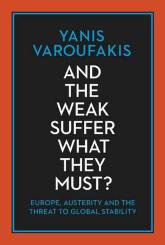
Yanis Varoufakis and the Weak Suffer What They Must Review
![DiEM0216-session1-0124[1].jpg](https://cdn2.opendemocracy.net/media/images/DiEM0216-session1-01241_z5H95qR.width-800.jpg)
Yanis Varoufakis at DiEM Session I, Volksbuhne. Arno-epitome. All rights reserved. I would similar to starting time this review by looking at Varoufakis' writing style: his manner is interesting. The circumstances of Varoufakis' life during the writing of this text were anything but conducive to the reflective processes that assistance adept writing. But, unlike many a scholar siloed inside academic arcana, the stylistic treadmarks of 2022 are only noticeable in this book considering Varoufakis writes so well.
Similar all great story tellers, Varoufakis' literary flare is not just a function of stylistic prowess. He gets right within the fears, desires and external constraints of the key players in the complex history of the Eurozone so that we come to understand the human reasons why Europe now is where she is. This 'getting inside' is a function of a precipitous analytical mind combined with a clear eyed commitment to the moral principles undergirding liberal autonomous politics and humane economic science. It is his combination of high humanist values with carefully calibrated applied rationality that guides his story telling and makes his style so clear and powerful. This is on fine display in the hardest office of any book to write, its opening.
The preface is a pearl: a vivid account of childhood in Greece under the fascist turmoil of the tardily 1960s. It is polished, penetrating and powerful writing which moves the moral consciousness of the reader. We encounter that his concerns arise from tragic contact with the deep things of human experience that are universal and should be our concerns too. There is an urgency underpinning this text requiring that the story he tells must be told now. Three features give the volume its solidity and importance: historical breadth and clarity, analytical incisiveness, and – to borrow a phrase from Ghandi – the moral power of its reasoning.
Telling it like information technology was
This book is far more than a re-statement of Varoufakis' 2011 book, The Global Minotaur.
Information technology fleshes out the narrative of the origins of Europe'due south present fiscal and political crisis, unpacked with a particular eye on Europe's present crunch. But the basic story line in The Global Minotaur – which as well provides the construction here – is a play in three acts.
Human activity Ane is ready in the years 1944 to 1971. When the present global economy was set up up at Bretton Woods, the US was gripped past a New Deal fear of international financial anarchy but was not prepared to let its dominance of the postal service-war globe sideslip in order to generate a truly self-balancing global economic system. This led to the US rejecting Keynes' program to construct a genuinely international currency and a genuinely international gear up of surplus and deficit rebalancing institutions. What the US did instead was a sort of Keynesian-calorie-free internationalism that relied on The states currency, United states of america controlled international institutions, and the massive United states surplus economic system to keep all the post-state of war boats (outside of the Communist sphere) floating.
Finance was tightly under political command during this era. Past investing their ain surplus into Germany and Japan in particular, the US was able to re-build Europe and Asia and recreate them – politically and economically – in something similar its ain image. On the whole, things worked exceptionally well for what nosotros now call the post-war boom (1949– 1971). But when the astronomical expense of the Cold War kicked in and the Usa stopped running a surplus, the Bretton Woods system simply vicious over, leaving the earth in a mess.
Act Two is the years 1971 to 2008. Here the US boldly re-configured the global economy then that – by releasing the financialized turn a profit desires of Wall Street from tight regulation – it was able to maintain global authority as a arrears economy. The Nixon Shock of 1971 produced the stagflation sickness of the 1970s which was and so 'cured' in the 1980s by the staggering success of financialized and transnationalized corporatism. Only the architecture of the post-Nixon area was inherently unstable, inherently disconnected from sustainable human and economic realities, and it all came crashing downwards in 2008.
Human activity Iii starts in 2008. Hither, later acts i and ii have both ended in tears, the global economy is terminally wounded and must either die or face up radical reconstructive surgery. Now, despite the various appearances of recovery, it is simply the case that the mechanisms and institutions that used to go on the global economical order in some sort of functional balance take all failed. We have simply just started Act Three, but it could end apace, and violently.
Information technology will crave unusual collective intelligence and fortitude to divert our path from disaster now. For today, the ideologies and vested power interests driving the prevailing financialized escape from economic and moral reality are at present deeply entrenched in what sociologists call our life-world. Neoliberalism and financialization have so finer defined political "realism" that our public soapbox simply refuses to recognize that we are hurtling towards a brutal unravelling of the prevailing global order if we simply proceed going as we are.
So, how does And the Weak Endure every bit they Must? take up this narrative and tell us things we did not know and need to know at present?
The border of our seats
Reading And the Weak Endure as they Must? is like reading a gripping thriller. It is a page turner because the plot itself is a relentless sequence of astonishing twists and turns driven by the cunning ingenuity and hubristic folly of its central protagonists.
Fifty-fifty if you know a lot virtually the Eurozone, Varoufakis' advisedly researched business relationship, with its vivid glimpses into the motivations and outlooks of key players, and its expansive breadth in appreciating the global dynamics pressuring localized decisions, is unerringly startling. Yet it is no novel. Varoufakis' book has something made-up stories can only mimic; the texture of existent history.
But hither is the key thing that Varoufakis has then carefully noticed. In the texture of real history, convenient illusions are typically a not bad deal more influential in the circles of power and normality than is truth. It is for this reason that, in real history, truth usually seems stranger than fiction. And yet, Varoufakis also notices that the texture of history is such that truth ever has the final say, no affair how hard the powers of illusion and convenience seek to keep the dream alive by helping u.s.a. to stay asleep.
Varoufakis' insight into the relationship between what normal mainstream people and the great and powerful want (even need) to believe, and what is actually going on, is a key characteristic of the significance of this book. He weaves his intricate and tense narrative material out of illusion and reality – the texture of existent history – past constantly shifting our gaze between 3 interconnected focal lengths.
With the first, Varoufakis enables us to see how the globe looks through the myopia of the common man'due south desire to adamantly hope that our leaders know what they are doing while nosotros only become on with our lives. This myopia is savagely reinforced by the news media and integrated with the myopia of European high power.
And that high power cannot see past the cease of its own nose, defined as it is by the bureaucratic echo-chamber of self-perpetuating institutional power (read Max Weber and Michel Crozier) and the autism of self-serving fiscal power.
This short-sighted focal length insight is and so overlaid with a 20 twenty focal length perspective provided by Varoufakis' forensic knowledge of how Eurozone power actually functions. Here nosotros go a nauseating sense of how badly awry things are when very bones macro-economical realities are simple banished from the 'negotiating' table laid out by the powers that be.
This perspective is in turn overlaid with a scope focus, the far-sighted and sweeping historical panorama which shows us why the Eurozone is what information technology is. This enables usa to run across – in the 1 account – the disjunction between 'normal' financial and public diplomacy orthodoxies, the 'realism' mandated by prevailing power interests, and what is really happening to Europeans.
Quantitative easing
One passage that encapsulates Varoufakis' sensitivity to the relationships between power, illusion and reality is his description of Mario Draghi's creatively adjusted awarding of Quantitative Easing to the Eurozone, bar Hellenic republic, in 2015. (See pages 186–192.) Draghi's manoeuvres are hither situated every bit part of a larger power struggle between the European Key Bank (ECB) and the Bundesbank.
Firstly Varoufakis explains what Quantitative Easing (QE) is. When things are going seriously financially incorrect and no 1 will borrow money, fifty-fifty when involvement rates hit nix, and then the troubled nation's central bank can buy debts from commercial banks in order to prevent interest rates from going negative and producing the total implosion of the cyberbanking sector. Japan did this in the 1990s and the United states of america did it in the aftermath of 2008. When performing QE, the central bank deposits money into accounts for the floundering commercial banks in exchange for their debts. The cardinal bank 'finds' the coin for this act past simply making it up. These accounts "are just digital numbers that the central banking concern conjures up and adds to the commercial banking concern's business relationship, held at the central banking company." (p187) The purpose of QE is to provide troubled commercial banks with the backbone to lend money to existent investors so that the existent economy can exist stimulated by investor spending and by the wage earner spending that results from investor fuelled employment. This is what will return the economy to health and get the banks out of problem (in theory).
However, the ECB is governed by the Maastricht Treaty and does not accept the same overt powers as key banks similar the Fed in the US. The ECB must exist a central banking company within a stunning set of limitations. Then Mr Draghi as President of the ECB has to be very clever in the way in which he performs key bank manoeuvres that might genuinely do good the entire Eurozone. This challenge is devilishly hard in the kickoff place, but on meridian of that the politics between the ECB and the Bundersbank is astonishingly thick with reprisals and power plays. So it tin can be no surprise that Eurozone QE has gone horribly wrong. With breathtaking precision, Varoufakis explains:
"QE works but, even under the best possible circumstances, information technology works neither well nor in the style it is intended to. The reason is that, for QE's virtuous wheel to start spinning, a multiple coincidence of impossible behavior must occur." (p187)
What ends upwardly happening – as in the U.s.a. – is that QE-supported nervous private banks do not lend money to real investors, but to nervous big companies who purchase back their ain shares in the stock market in society to increase their share cost. So money conjured out of zilch is used to inflate non-productive financialized share toll bubbles. This, unsurprisingly, has no real positive impact on the economy or on the banks. So the Eurozone QE attempt did non work to amend real investment and it concluded upwardly (accidentally) savagely devaluing German pension funds. (To find out how, see page 190.) All this happened at the aforementioned time the Syriza – equally a Euro-power side testify – was beingness crushed past the troika for the heresy of disbelieving that economic system-killing thrift was good for information technology.
This is just one modest snap shot of Varoufakis' masterful account of Eurozone power games. Fascinatingly illuminating pictures like this run through the entire book. But it is Varoufakis' power to situate historical particularities within a larger context of pregnant, and to be sensitive to the way in which illusion, belief and reality collaborate in real economies, existent politics and (un)real loftier finance games, as well every bit seeing what affect these games have on existent people, that makes this book so skilful.
A call to activity
But this book is not just illuminating. Information technology is a call to moral enkindling and to intelligent, determined and humane political activeness. The title comes from one of the founding classics of western political writing: Thucydides' History of the Peloponnesian State of war. In this history Thucydides recounts an unprovoked display of majestic dominance by the powerful Athenian navy over the people of the Island of Melos in 416 BC. The Melians had advisedly kept themselves neutral in relation to the war between Athens and Sparta, simply that was not good enough for the Athenians. So the Athenians decided to align Melos with Athens by force. The terms offered were fidelity, with a devastating tribute, or be destroyed. The Melians protested that such a need was unjust and in violation of a proper fear of the gods. If Athens did this evil and brutally self-interested thing it would surely come up back on them in the end. The Athenian delegation responded to Melos thus:
"Right, every bit the earth goes, is only in question between equals in power, while the stiff do what they can and the weak suffer what they must." (Book 5, line 89.)
Strangely Thucydides is oft 'credited' with putting frontward a "political realist" account of power in his History, simply information technology is not what his History shows us. Thucydides – himself an Athenian – clearly thinks that the Athenian empire was too cruel and likewise instrumental in their use of weaker vassal states under their sphere of influence, and that such cruelty undermined their power (he died before the last defeat of Athens at the end of the Peloponnesian war). I would argue that he thinks it an objective feature of history that matters of justice and respect for the rights of the weak cannot be simply over-ridden because it is within the reach of the powerful to and then do.
This notion that justice is non a thing of what the powerful can extract by forcefulness, that there are moral realities built into homo history that cannot exist overridden by violence is deeply ingrained in classical Greek thinking. Simone Weil's amazing essay "The Iliad or poem of force" brings this out keenly. Plato besides, entirely rejects the "realist" arguments of Thrasymachus in volume one of The Republic. Shakespeare'south historical plays too work around the theme that ability tries to avoid moral accountability, so that whilst the strong frequently do equally they will and the weak often endure what they must, yet unjust power is inherently self-subversive.
Keen observers of the human being condition such as Thucydides, Plato and Shakespeare give us potent reason to remember that what we telephone call "political realism" has no durability in holding human gild together – let lonely in nurturing human flourishing – considering it is, in the end, unrealistic.
There is an unavoidable moral grain to all human actions which is pragmatically ignored to the great peril of the powerful. So it is non only immoral for the powerful to do what they will at the expense of the weak, it is as well irrational, for history and unproblematic clear reasoning shows us that things only work well for the powerful if they are grounded in the justice that facilitates the flourishing of the weak.
This also is Yanis Varoufakis' guiding moral conviction in his assay of the politics and economic science of contemporary Europe. Varoufakis struggles with his Europe and it is a passionate struggle, characterised past a mettlesome existentially ventured optimism. So called 'realists' oft dismiss Varoufakis as idealistic and unrealistic, but Varoufakis tin can see disaster looming with very, very articulate eyes. His amazing promise is premised on the belief that if he can help enough ordinary citizens of the world to meet that looming disaster too, and then collective activeness from the grass roots up tin be taken to divert us from catastrophic destruction. In that sense he is on a mission to 'telephone call us out' to join the public assembly and have the future of our polis out of the hands of our misguided leaders and into our ain.
Varoufakis wants us to brand power and finance accountable to real people and real communities lest we find ourselves in a terrifying postmodern 1930s. He sounds a very important call. We should respond to this call and make the liberal democratic idea that we say we believe in piece of work. If we do not make power answerable to the people ruled, if we do not make power serve the good of the majority of ordinary people, then information technology is our failure when our leaders carry us over the cliff confront of destruction.
The state of affairs is urgent. We practice non take much time earlier the hubris and unreality of gimmicky financialization and geopolitical cocky-interest destroys the world as we know it. And the Weak Suffer what they Must? has laid it all out before us in relation to the time to come of Europe, and of the globe. But the key element in Varoufakis's title is the question marker. Volition we believe that brute power with its self-destructive and organisation destroying characteristics is uncomplicated how things are, or do we believe it is against our humanity and against our intelligence to let the powerful do equally they will?
Source: https://www.opendemocracy.net/en/can-europe-make-it/yanis-varoufakis-and-weak-suffer-what-they-must-book-review/

Post a Comment for "Yanis Varoufakis and the Weak Suffer What They Must Review"